


Based on the 2026 Canadian Employment Pulse Check, conducted by Borderless AI — a survey of 1,502 adult Canadians including 905 employed or job-seeking respondents, conducted April 21–23, 2026.
Artificial intelligence has been a fixture in workplace conversations for several years now. But 2026 marks a turning point: AI has moved from hypothetical disruption to lived experience for Canadian workers. And the data tells a story that's more complex, and more actionable, than any single headline can capture.
This post covers every major finding from the 2026 Canadian Employment Pulse Check, released by Borderless AI. Whether you're a job seeker, an HR leader, a manager, or a policy-watcher, here's the full picture.
The Headline: Nearly Half of Employed Canadians Say AI Has Touched Their Career
Let's start with the top-line finding: 46% of employed Canadians say AI has had an impact on their long-term career trajectory.
That number alone is significant, but what makes it useful is the breakdown of how that impact is landing.
Of those affected:
- 26% feel more secure and are actively building new AI skills
- 19% feel less secure, worried that automation is eroding their role or career path
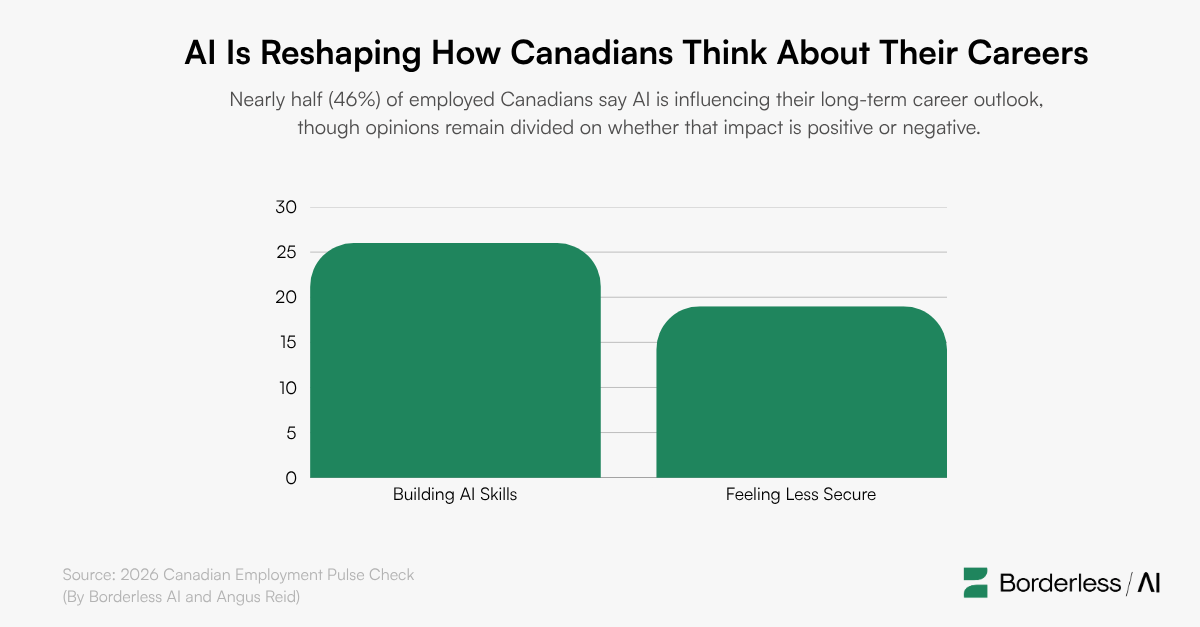
The workforce isn't splitting into "winners" and "losers" so much as into "adapters" and "waiters." The 26% who feel more secure aren't in fundamentally different jobs, they've made a deliberate choice to learn, adjust, and position themselves as AI-fluent workers.
"Employees are no longer fearful that AI can replace them, and are finding ways to market themselves as experts to unlock the potential of AI tools. AI is only as effective as those who are using it — becoming an in-demand skill in today's job market." — Willson Cross, CEO and Co-founder, Borderless AI
Finding #1: University Graduates Feel the Impact Most, Including the Insecurity
One of the most counterintuitive findings in the report involves education level. You might expect that higher education provides a buffer against AI-related disruption. The data suggests the opposite.
University-educated Canadians are nearly twice as likely to feel the impact of AI on their careers, and nearly twice as likely to feel insecure about it. Knowledge work, analytical roles, and white-collar careers are squarely in AI's domain, and workers in those fields know it.
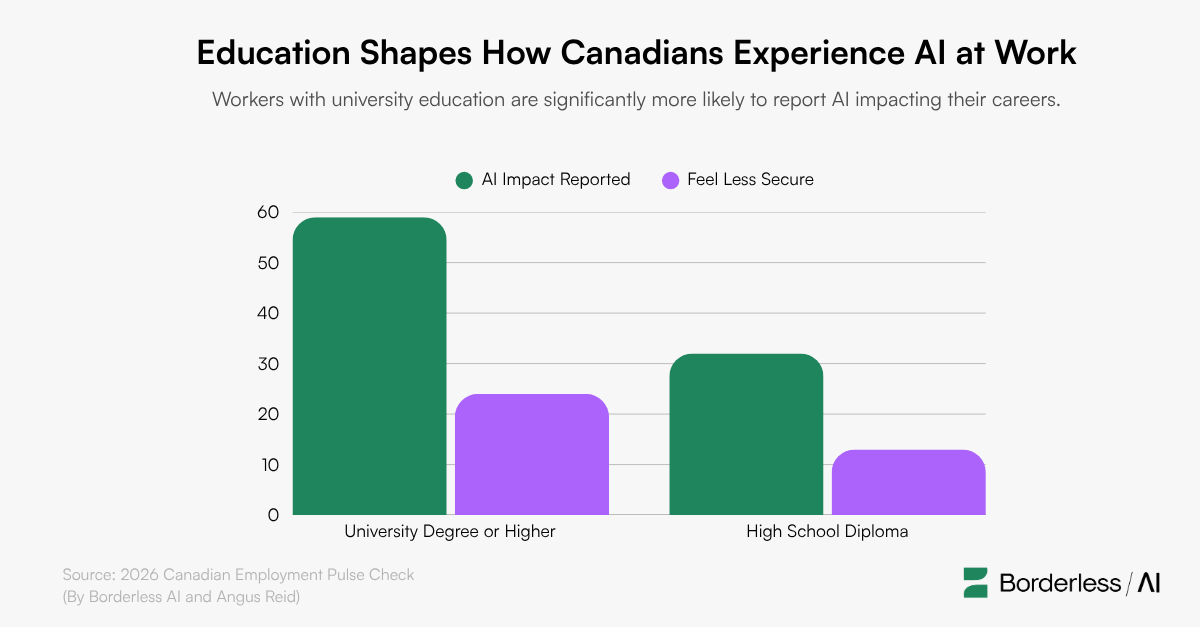
That said, this group is also the most proactive in response: 26% of university graduates are actively building new skills because of AI, the highest of any education segment. Higher perceived threat is driving higher investment in adaptation.
What this means: The assumption that credentials are career armor is being tested. Degree-holders in knowledge-based fields need to treat AI fluency as an extension of their professional education, not an optional add-on.
Finding #2: Young Canadians (18-24) Are the Most Disrupted Age Group
The impact of AI is not evenly distributed across generations. Younger workers feel it most acutely, and the numbers are striking.
- 57% of Canadians aged 18–24 say AI is impacting their long-term career opportunities, the highest proportion of any age group. And of those young Canadians feeling the impact:
- 49% say they feel less secure, are reconsidering their career path, or are considering switching industries entirely
This is happening against a backdrop of already-elevated youth unemployment. As of March 2026, Statistics Canada reported youth unemployment at 13.8%. AI isn't the sole driver of that figure, but it is compounding anxiety among a generation entering a market that was already more competitive than the one their predecessors entered.
Older Canadians report meaningfully less AI-related career disruption, a function of established roles, deeper institutional knowledge, and stronger professional networks. Entry-level workers have fewer of those buffers.
What this means for young workers: Position yourself as someone who makes AI more effective, not someone competing with it. Build a visible portfolio of judgment-intensive work. Consider which sectors are genuinely growing rather than just which job titles sound safe.
What this means for employers: If you're automating away entry-level roles, you're also eroding the pipeline of future senior employees. Short-term efficiency gains can create long-term succession problems.
Finding #3: Wage Stagnation Is the Dominant Fear, Not AI Replacement
Here's the finding that most challenges the prevailing media narrative: when Canadians rank their biggest concerns about work, AI displacement isn't at the top.
More than twice as many Canadians fear their wages won't keep up with their cost of living than fear losing their job to AI entirely. This reflects a shift in how workers are experiencing the economy: inflation has been stubborn, cost of living remains elevated, and the labor market has shifted from an employee's market to an employer's market, reducing workers' bargaining power and their ability to job-hop for meaningful pay increases.
The AI fear hasn't disappeared, 19% is not a small number, but it has been contextually displaced by more immediate financial anxieties.
What this means for employers: Compensation strategy is your most urgent retention lever. Workers are watching whether their real wages are growing or shrinking. Vague promises of "competitive pay" without transparent data will lose you candidates who have done their homework.
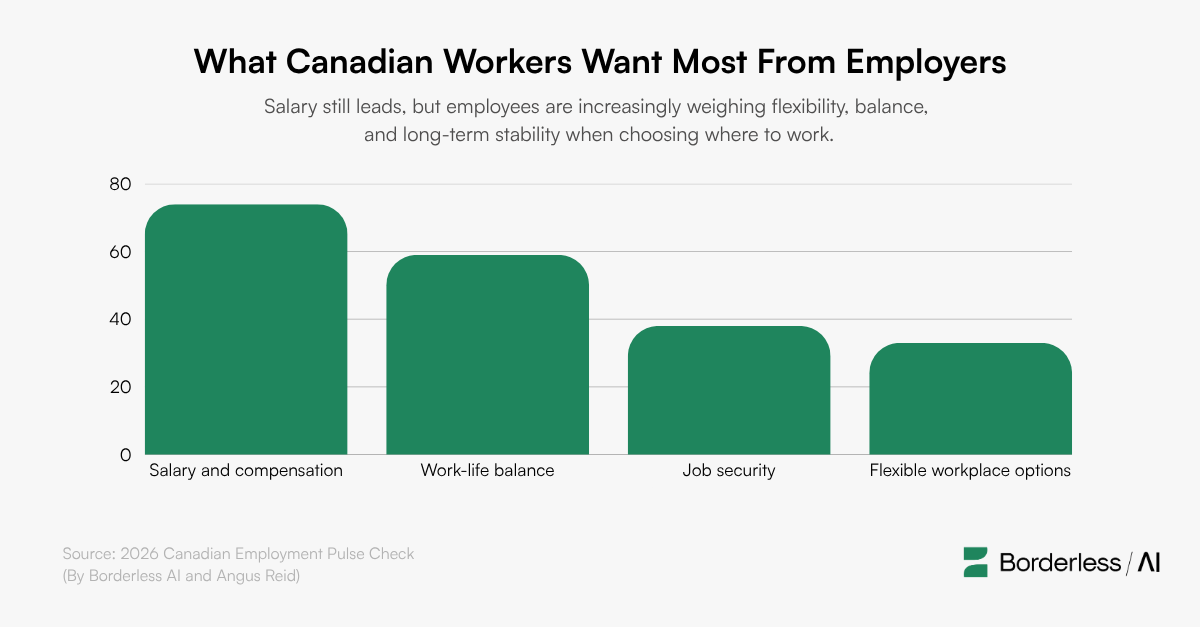
Finding #4: What Canadian Workers Actually Want From Employers
When selecting an employer, Canadians are clear about their priorities:
Salary leads decisively, but the margin between #1 and #2 is narrower than many employers expect. Work-life balance at 59% is effectively a near-universal consideration, not a differentiator, but a baseline expectation.
The Gender Gap on Flexibility
The data reveals a significant divide between men and women on workplace flexibility:
- 40% of women consider flexible workplace options a key factor in choosing an employer
- 26% of men say the same
This 14-point gap matters practically. A hybrid or remote policy that exists on paper but is quietly discouraged in practice is a specific form of broken trust and it falls harder on women, who still disproportionately manage caregiving responsibilities alongside their careers.
Young Workers: Salary Is Everything (For Now)
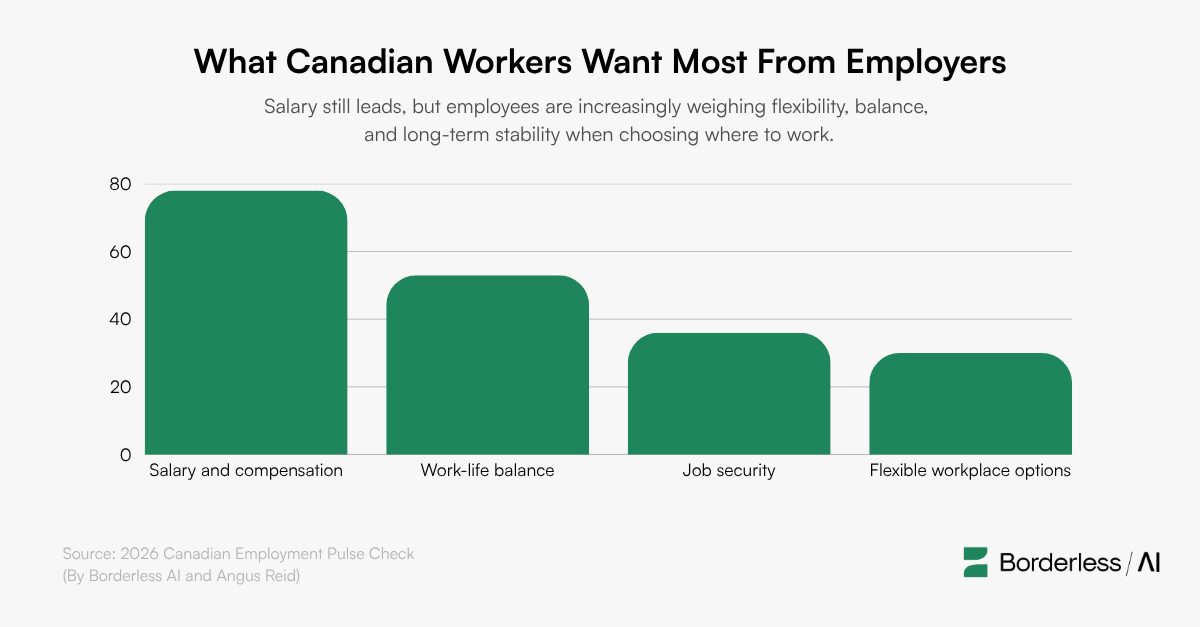
For Canadians aged 18-24, salary is the top priority for a striking 78% of respondents. With high cost-of-living pressures, rising education debt, and a tight entry-level market, the financial calculation is immediate and concrete for this group.
Employers competing for early-career talent cannot rely on culture, purpose, or future upside to close offers. The base comp needs to be front and center.
Finding #5: How Canadians Weigh International Employers
Canada's job market includes a healthy mix of domestic and international companies, and the survey asked directly: what would motivate a Canadian worker to choose an international employer over a Canadian one?
The answer is clear and largely financial:
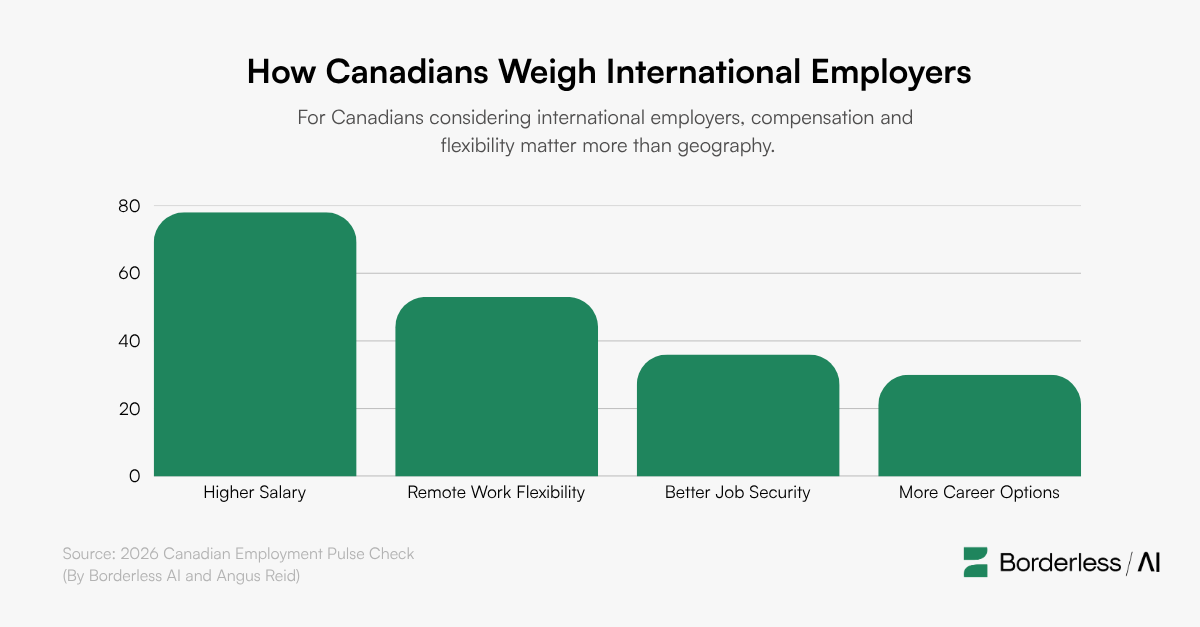
"Canadian pride is alive in Canada's job market," says Willson Cross, "but as the job market tightens, what employers can offer employees becomes the deciding factor."
For international companies hiring Canadian talent, this is encouraging: there's no deep cultural preference for domestic employers that you need to overcome. Lead with a strong financial and flexibility offer, and you're competitive.
For Canadian employers, it's a warning: the talent you've developed will consider leaving for better compensation. Benefits, matching contributions, additional leave, and supplementary perks are increasingly the tools available when base salary bands are narrow.
The Big Picture: What This Data Means in 2026
Taken together, the 2026 Canadian Employment Pulse Check tells a coherent story about where the Canadian workforce stands:
AI has arrived, but it’s not just replacing jobs. It’s creating a new class of people: adapters. The workers who feel most secure are those who are actively investing in AI fluency. The workers most at risk are those who are waiting for clarity before acting.
Financial anxiety has overtaken AI anxiety as the dominant concern. Workers aren't primarily afraid of robots. They're afraid of their purchasing power eroding in a market where they have less leverage than they did two years ago.
Young Canadians are at a genuine inflection point. Elevated youth unemployment, AI's concentrated impact on entry-level roles, and real cost-of-living pressure are combining into a challenging moment for the generation entering the workforce. The good news is that the workers who understand this landscape, and respond strategically, are building durable advantages.
What employers offer is the deciding factor. Salary leads, but flexibility, security, and career opportunity all matter. The companies that understand this holistically, and deliver on it, will win the talent market in 2026 and beyond.
Key Statistics at a Glance
About the Research
The 2026 Canadian Employment Pulse Check was conducted by Borderless AI from April 21–23, 2026, among a representative sample of 1,502 online adult Canadians, including 905 who work or are looking for work. Respondents are members of the Angus Reid Forum. The survey was conducted in both English and French. Margin of error: ±2.5% (total sample) / ±3.3% (working sample), 19 times out of 20.
Borderless AI is an AI-native Employer of Record (EOR) and global payroll platform that helps companies hire, pay, and manage talent across 170+ countries.